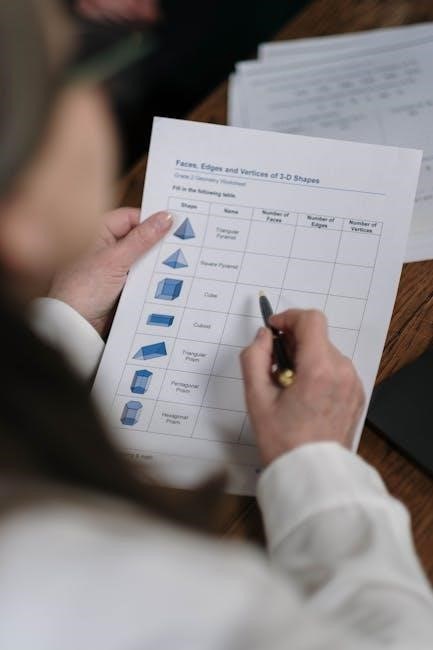
Similar Figures Worksheet with Answers PDF: A Comprehensive Plan
Kuta Software provides comprehensive pre-algebra worksheets focusing on similar figures, including finding missing sides. These PDF resources, dated back to 2012, offer practice problems and solutions.
Weebly hosts review materials and keys, complementing the Kuta Software worksheets, aiding students in mastering similar figure concepts and proportional reasoning skills.
Similar figures represent a fundamental concept in geometry, exploring shapes that maintain proportional relationships despite variations in size. These figures, whether triangles, polygons, or more complex forms, share identical angles and corresponding sides that are in a constant ratio. Understanding this proportionality is key to solving problems involving scale, measurement, and real-world applications.
Worksheets, particularly those offered in PDF format by resources like Kuta Software, serve as invaluable tools for introducing and reinforcing this concept. These resources, often geared towards pre-algebra students, provide structured practice in identifying similar figures and calculating missing dimensions. The availability of answer keys allows for self-assessment and independent learning.
Furthermore, supplementary materials hosted on platforms like Weebly, such as review documents, enhance the learning experience by providing additional context and problem-solving strategies. Mastering similar figures lays a crucial foundation for more advanced geometric concepts and practical applications in fields like architecture and mapping.
Defining Similar Figures
Similar figures are geometric shapes that possess the same shape but can differ in size. A formal definition hinges on two critical criteria: equal corresponding angles and proportional corresponding sides. This means that each angle in one figure has an identical counterpart in the similar figure, and the ratios between the lengths of corresponding sides are constant.
Worksheets, readily available as PDF downloads from sources like Kuta Software, frequently begin by establishing this precise definition. These resources often present pairs of figures and task students with verifying similarity by checking both angular equality and side proportionality. The inclusion of answer keys allows students to confirm their understanding and identify areas needing further review.
Pre-algebra level materials emphasize recognizing these characteristics through visual inspection and applying proportional reasoning. Supplementary resources, such as those found on Weebly, often reinforce this definition with practical examples and step-by-step solutions, solidifying the foundational understanding of similar figures.
Key Properties of Similar Figures
Similar figures maintain several defining properties crucial for problem-solving. Primarily, corresponding angles are congruent – their measures are equal. Secondly, corresponding sides are in proportion, meaning the ratio between their lengths remains constant across all corresponding pairs. Worksheets, particularly those from Kuta Software in PDF format, heavily emphasize these properties.
These worksheets often present diagrams where students must identify corresponding angles and sides, then calculate the ratios to confirm similarity. The availability of answer keys is vital for self-assessment and error correction. A key property is that the ratio of areas is the square of the scale factor, a concept frequently tested.
Resources like those hosted on Weebly supplement these exercises by providing detailed explanations and worked examples. Understanding these properties is fundamental for solving problems involving missing side lengths, scale factors, and area calculations within similar figures, as demonstrated in the practice problems.
Corresponding Angles in Similar Figures
A cornerstone of similar figures is the congruence of their corresponding angles. This means that if two polygons are similar, each angle in one polygon has an equal measure to its corresponding angle in the other. Worksheets, such as those available as PDFs from Kuta Software, frequently assess this understanding.
These worksheets often require students to identify corresponding angles based on the order of vertices in the similarity statement. Correctly identifying these angles is the first step in verifying similarity and setting up proportional relationships for corresponding sides. The answer keys provided allow for immediate feedback on accuracy.
Weebly-hosted resources often visually demonstrate this property, highlighting congruent angles in paired figures. Mastering this concept is crucial because it establishes the foundational relationship upon which all other properties of similar figures – like proportional sides – are built. Exercises focus on recognizing angle relationships before tackling side calculations.
Ratios and Proportions in Similar Figures
Similar figures exhibit a consistent relationship between their corresponding sides, expressed as ratios. These ratios form proportions, a core concept emphasized in worksheets from sources like Kuta Software, available as PDFs. Students practice setting up and solving these proportions to find missing side lengths.

Worksheets typically present pairs of similar polygons and ask students to establish the ratio between corresponding sides. This ratio remains constant throughout the figures. The answer keys provide step-by-step solutions, demonstrating how to correctly formulate and solve the proportions using techniques like cross-multiplication.
Resources hosted on Weebly often reinforce this with practical examples and review materials. Understanding ratios and proportions is essential for scaling figures, determining unknown dimensions, and applying similarity in real-world scenarios. The exercises build from basic ratio identification to more complex proportional reasoning problems.
Scale Factor: Understanding the Ratio
The scale factor represents the ratio between corresponding sides of similar figures, a key concept practiced in worksheets offered by Kuta Software in PDF format. It indicates how much larger or smaller one figure is compared to another. Worksheets focus on identifying this ratio and applying it to determine unknown side lengths.
A scale factor greater than one signifies an enlargement, while a scale factor between zero and one indicates a reduction. Kuta Software’s materials provide numerous examples where students calculate the scale factor given two similar polygons. Answer keys detail the process, ensuring accurate calculations.
Review materials, such as those found on Weebly, often emphasize that the scale factor is consistent for all corresponding sides within a pair of similar figures. Mastering this concept is crucial for solving proportional problems and understanding geometric scaling. The worksheets progressively challenge students with varying levels of complexity.
Calculating the Scale Factor
Calculating the scale factor involves dividing the length of a side in the new figure by the length of its corresponding side in the original figure, as demonstrated in Kuta Software’s worksheets. These PDF resources provide ample practice with this fundamental skill. Students learn to consistently pair corresponding sides for accurate calculations.
The worksheets often present pairs of similar figures with labeled side lengths, prompting students to determine the scale factor. Answer keys are included, allowing for self-assessment and error correction. It’s crucial to ensure both sides used in the division are corresponding – a common source of errors.

Weebly’s review materials reinforce that the scale factor remains constant throughout the entire set of similar figures. Therefore, calculating it using any pair of corresponding sides should yield the same result. Kuta Software’s progressive exercises build confidence in applying this principle to various geometric shapes.
Using Scale Factor to Find Missing Sides
Once the scale factor is determined, Kuta Software’s worksheets guide students to apply it to find missing side lengths in similar figures. This involves multiplying the length of a known side in the original figure by the scale factor to obtain the corresponding side length in the new figure – or vice versa.
The PDF exercises frequently present diagrams with one or more missing side lengths, requiring students to strategically utilize the scale factor. Answer keys provide immediate feedback, enabling students to verify their calculations and understand any mistakes made in applying the multiplication.
Weebly’s resources emphasize the importance of correctly identifying corresponding sides before applying the scale factor. Kuta Software’s worksheets progressively increase in complexity, challenging students to apply this skill to various polygons and real-world scenarios, solidifying their understanding of proportional relationships.
Setting Up Proportions for Missing Sides
Kuta Software’s similar figures worksheets heavily emphasize using proportions to solve for unknown side lengths. Students learn to establish equivalent ratios between corresponding sides of similar figures. This involves carefully aligning the known values and the unknown variable within the proportion.
The PDF resources demonstrate how to write proportions like a/b = x/y, where ‘a’ and ‘b’ are known sides from one figure, and ‘x’ is the missing side, with ‘y’ being its corresponding side in the similar figure. Weebly materials reinforce this concept with clear examples and step-by-step instructions.
These worksheets provide ample practice in setting up these proportions correctly, a crucial skill for success. The included answer keys allow for self-assessment, ensuring students grasp the fundamental principle of maintaining equivalent ratios when dealing with similar figures and missing measurements.
Solving Proportions: Cross-Multiplication
Kuta Software’s similar figures worksheets consistently utilize cross-multiplication as the primary method for solving proportions. Once a proportion is established – such as a/b = c/x – students are guided to multiply the numerator of the first fraction by the denominator of the second (a * x), and vice versa (b * c).
This creates a simple algebraic equation (a * x = b * c) that can then be solved for the unknown variable ‘x’. The PDF format of these worksheets allows for clear presentation of each step, reinforcing the cross-multiplication process. Weebly resources further support this by providing worked examples and detailed solutions.
The answer keys included with the worksheets demonstrate the correct application of cross-multiplication, enabling students to verify their work and identify any errors in their calculations. Mastering this technique is essential for efficiently finding missing side lengths in similar figures.
Applications of Similar Triangles
Similar triangles form the foundation for many practical applications explored within the Kuta Software and Weebly resources. The worksheets, available as PDF downloads, often present scenarios requiring students to identify similar triangles and utilize their properties to solve for unknown lengths.
These applications frequently involve real-world contexts, implicitly introducing concepts like shadows and similar triangles. While not explicitly detailed in the provided snippets, the proportional relationships inherent in similar triangles are key to calculating heights or distances indirectly. The worksheets emphasize setting up proportions based on corresponding sides.
The answer keys provide solutions demonstrating how to apply these principles. Though architecture and map scales aren’t directly shown in the excerpts, the underlying mathematical principles are practiced through solving for missing side lengths, preparing students for these broader applications. The focus remains on mastering the core proportional reasoning skills.
Similar Polygons: Beyond Triangles
Kuta Software’s worksheets, offered as PDF documents, extend the concept of similarity beyond triangles to encompass a broader range of polygons. These resources maintain the core principle of proportional side lengths and congruent corresponding angles, crucial for establishing similarity.
The worksheets present pairs of similar polygons, challenging students to identify corresponding sides and angles. A key skill practiced is determining missing side lengths when the polygons are similar, relying heavily on setting up and solving proportions – a technique reinforced with provided answer keys.
While the snippets don’t detail specific polygon types (e.g., quadrilaterals, pentagons), the underlying methodology remains consistent. Students apply the same proportional reasoning used with triangles to these more complex shapes. The Weebly review materials likely complement this, solidifying understanding of the broader concept of similar figures.
Identifying Similar Polygons
Kuta Software’s worksheets, available in PDF format, heavily emphasize the ability to correctly identify similar polygons. This involves a systematic check of two critical criteria: ensuring all corresponding angles are congruent and verifying that corresponding sides are in proportion.
The worksheets present various polygon pairs, requiring students to analyze their angles and side lengths. Students must determine if the ratios between corresponding sides are equal across all pairs. This skill is foundational for subsequent calculations involving scale factors and missing side lengths.
The provided snippets from Kuta Software demonstrate a focus on practice problems designed to build this identification skill. While the Weebly resource isn’t directly detailed, it likely provides supplementary exercises or review materials to reinforce the concepts of congruence and proportionality, essential for accurately identifying similar polygons.
Finding Missing Sides in Similar Polygons

Kuta Software’s similar figures worksheets, offered as PDF downloads, dedicate a significant portion to exercises focused on finding missing sides within similar polygons. These problems build upon the foundational skill of identifying similarity, requiring students to apply proportional reasoning.
The worksheets present pairs of similar polygons with one or more side lengths unknown. Students are expected to establish ratios between corresponding sides of the known polygon and use these ratios to calculate the missing lengths in the other polygon. This often involves setting up and solving proportions.
The examples provided by Kuta Software illustrate this process, showcasing how to determine the scale factor and apply it to find the unknown side lengths. The Weebly resource likely complements this with additional practice problems and potentially step-by-step solutions, reinforcing the application of proportional relationships.
Working with Perimeter and Similar Figures
Similar figures worksheets, particularly those from Kuta Software in PDF format, extend beyond simply finding missing sides to explore the relationship between perimeter and similarity. A core concept presented is that the perimeters of similar polygons are directly proportional to their corresponding side lengths.

These worksheets often present scenarios where the perimeter of one polygon is known, and students are tasked with calculating the perimeter of a similar polygon, given a scale factor or a few corresponding side lengths. This requires first determining the scale factor and then applying it to the perimeter.
The Kuta Software materials likely include problems that require students to calculate individual side lengths before determining the perimeter, reinforcing the connection between side ratios and overall perimeter. Supplementary resources, like those found on Weebly, may offer additional practice and detailed solution keys.
The Ratio of Perimeters in Similar Figures
Similar figures worksheets, readily available as PDF downloads from sources like Kuta Software, consistently emphasize a fundamental principle: the ratio of perimeters of similar polygons mirrors the ratio of their corresponding sides. This is a direct consequence of perimeter being a linear measurement.
If two polygons are similar with a scale factor of ‘k’, then the ratio of their perimeters is also ‘k’. Worksheets often present problems requiring students to identify this ratio, either by directly providing side length ratios or by requiring them to calculate the scale factor first.

Kuta Software’s materials likely include exercises where students are given the perimeters of two similar figures and asked to determine the scale factor. Resources on platforms like Weebly may offer step-by-step solutions and additional practice problems to solidify understanding of this crucial relationship.
Area and Similar Figures
Similar figures worksheets, particularly those in PDF format from Kuta Software, demonstrate that the relationship between the areas of similar figures differs from that of their perimeters. While perimeters scale linearly, areas scale quadratically. If the scale factor between two similar figures is ‘k’, the ratio of their areas is k2.
These worksheets frequently present scenarios where students must calculate the area of one figure given the area of a similar figure and the scale factor. Conversely, problems may require determining the scale factor when areas are known.
Kuta Software’s resources likely include examples involving squares, rectangles, and triangles, reinforcing this area-scaling principle. Supplementary materials, potentially found on sites like Weebly, may offer detailed solutions and practice exercises to ensure students grasp this non-intuitive, yet vital, concept in geometry.
The Ratio of Areas in Similar Figures
Similar figures worksheets, often available as PDF downloads from sources like Kuta Software, consistently emphasize that the ratio of the areas of similar figures is equal to the square of the scale factor. This fundamental principle is crucial for solving various geometric problems.
These worksheets typically present problems requiring students to determine this ratio given the scale factor, or conversely, to calculate the scale factor when the ratio of areas is provided. The exercises often involve two-dimensional shapes like triangles, squares, and rectangles.
Kuta Software’s materials likely include step-by-step examples illustrating how to apply this concept. Resources found on platforms like Weebly may offer additional practice problems and detailed answer keys, reinforcing understanding. Mastering this ratio is essential for tackling real-world applications involving scaling and proportional reasoning.
Using Ratios to Find Area of Similar Figures
Similar figures worksheets, commonly found in PDF format from resources like Kuta Software, frequently present scenarios where students must utilize ratios to determine the area of similar figures. These problems build upon the core concept that the ratio of areas is the square of the scale factor.
Typically, these worksheets provide the dimensions of one figure and the scale factor relating it to a similar figure. Students then apply the scale factor to find corresponding dimensions of the second figure and subsequently calculate its area.
Kuta Software’s materials likely include examples demonstrating this process, while supplementary resources on platforms like Weebly may offer practice problems with detailed solutions. Understanding this application is vital for solving geometric problems and real-world scaling scenarios. The PDF format ensures accessibility and ease of use for students practicing these concepts.
Real-World Applications of Similar Figures
Similar figures aren’t just abstract mathematical concepts; they have numerous practical applications, often explored through problems in worksheets available as PDF downloads, such as those from Kuta Software. These applications demonstrate the relevance of proportional reasoning.
Architecture heavily relies on similar figures for scaling blueprints and ensuring structural integrity. Map scales are a direct application, representing large distances using proportional reductions. Even seemingly unrelated scenarios, like determining the height of objects using shadows and similar triangles, utilize these principles.
Worksheets often present word problems mirroring these real-world scenarios, challenging students to apply their understanding of scale factors and ratios. Resources like those found on Weebly may provide contextual examples. Mastering these concepts, reinforced through practice with PDF worksheets, equips students with problem-solving skills applicable beyond the classroom.
Architecture and Similar Figures
Architecture fundamentally depends on the principles of similar figures for design, scaling, and construction. Blueprints, essentially scaled-down representations of buildings, rely on maintaining proportional relationships between different elements. This ensures structural stability and aesthetic consistency.
Architects utilize scale factors to translate designs from small models to full-size structures, guaranteeing that all components remain proportionally correct. Worksheets, often available as PDF documents – like those from Kuta Software – frequently include problems mirroring this process, asking students to calculate dimensions based on given scales.
The consistent application of similar figures ensures that arches, windows, and other architectural details maintain their intended shape and proportion across varying sizes. Resources found on platforms like Weebly may offer examples illustrating these applications. Practicing with worksheets and their answer keys solidifies understanding of these crucial architectural principles.
Map Scales and Similar Figures

Map scales are a direct application of similar figures, representing large geographical areas in a reduced, proportional format. The map itself is a smaller, similar version of the actual terrain, maintaining the same angles and shapes but with scaled-down distances.

Understanding ratios and proportions – core concepts in similar figures – is crucial for interpreting map scales. A scale of 1:100,000, for example, indicates that one unit on the map represents 100,000 of the same units in reality. Worksheets, often available as PDFs, like those from Kuta Software, provide practice in calculating actual distances using map scales.
These exercises often involve setting up and solving proportions, mirroring the techniques taught in pre-algebra. Resources on sites like Weebly may offer real-world examples of map scale calculations. Mastering these skills, reinforced by worksheet practice and answer keys, is essential for navigation and geographical analysis.
Shadows and Similar Triangles
The relationship between objects and their shadows provides a classic illustration of similar triangles. The object and its shadow, along with the sun’s rays, form two similar right triangles. This principle allows us to calculate unknown heights or distances using proportional reasoning.
Worksheets focusing on similar figures, often available as PDFs from resources like Kuta Software, frequently include problems involving shadow lengths. These exercises require students to identify corresponding sides in the similar triangles and set up proportions to solve for missing measurements.
The ability to apply scale factors, a key concept in similar figures, is vital for these calculations. Supplementary materials, such as those found on Weebly, may offer step-by-step solutions and practice problems with answer keys. Mastering this application reinforces understanding of proportional relationships and geometric principles.
Worksheet Examples: Finding Missing Sides
Worksheets dedicated to similar figures, commonly found as PDFs (like those from Kuta Software), heavily emphasize finding missing side lengths in similar polygons, particularly triangles. These examples typically present pairs of similar figures with one or more side lengths unknown.
Students are expected to identify corresponding sides – a crucial step – and then establish a proportion. The proportion reflects the equality of ratios between corresponding sides. Cross-multiplication is then employed to solve for the missing variable, representing the unknown side length.
Kuta Software’s worksheets often include multiple problems of increasing difficulty, ranging from simple triangle comparisons to more complex polygon scenarios. Resources like those hosted on Weebly provide answer keys, allowing students to verify their solutions and understand the correct approach. These exercises build proficiency in applying scale factors and proportional reasoning.
Worksheet Examples: Calculating Scale Factor
PDF worksheets focusing on similar figures, such as those offered by Kuta Software, frequently include exercises dedicated to determining the scale factor between two similar polygons. These problems present pairs of figures and require students to calculate the ratio representing the enlargement or reduction.
Typically, students identify corresponding sides – sides in the same relative position on each figure. The scale factor is then found by dividing the length of a side in the larger figure by the length of its corresponding side in the smaller figure. This yields a numerical value indicating the proportional change in size.

Worksheets often present scenarios where the scale factor needs to be applied to find missing side lengths, as highlighted in Kuta Software’s materials. Weebly-hosted resources provide answer keys for self-assessment. Mastering this skill is fundamental to understanding the relationships within similar figures and applying proportional reasoning.
Answer Keys and Solutions
Similar figures worksheet with answers PDF resources, notably those from Kuta Software, are invaluable due to their inclusion of detailed answer keys and step-by-step solutions. These PDF documents provide not just the final answers, but also the methodology used to arrive at them, fostering a deeper understanding of the concepts.
Kuta Software’s worksheets systematically present solutions, demonstrating how to calculate missing side lengths, determine scale factors, and apply proportional reasoning. These solutions often include clear explanations of each step, making it easier for students to identify and correct any errors in their own work.
Complementary resources, like those found on Weebly, often provide additional answer keys and worked examples. Access to these solutions empowers students to independently verify their understanding and build confidence in their ability to solve problems involving similar figures.